

 |
Insects
have been around for 350 million years while humans have been around
for approximately 10,000 years. |
 |
There
are nearly one million kinds (species) of insects, with many thousands
or even millions, yet to be discovered. |
 |
Insects
make up about 60% of all known animals.
|
 |
At
least one-third of the insects are in the order Coleoptera - the
beetles. |
 |
Less
than 5% of the insect species are considered harmful. |
 |
In
many countries and cultures, insects are eaten because of their
high protein content. |
 |
Many
insects are valuable to us since they pollinate many of the fruits
and vegetables we eat.
|
 |
Insects
play an important role in the balance of nature. |
 |
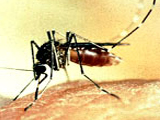
Only
female mosquitoes bite. |
 |
A
bee can sting only one time and then dies when it removes it's stinger. |
 |
The
skeleton of an insect is on the outside of the body, unlike a human's
skeleton, which is inside the body. |
 |
Many
insects smell with their antennae. |
 |
Insects
are cold-blooded creatures. |
 |
All
insects have three pairs of jointed legs. |
 |
The
time required to complete one life cycle in insects can vary from
a few days to as long as seventeen years. |
 |
In
some species, eggs can complete development without being fertilized.
This is known as parthenogenetic reproduction.
|
 |
It
is not unusual for an insect to be able to lift 50 or more times
its own weight. |
 |
If
humans had the same relative jumping ability as a flea, they could
broad jump 215 metres and high jump 140 metres. |
 |
Spiders are not insects, they are arachnids. |